Perón government
Los pacientes del doctor GarcíaThe Perón government appears as a political power that turns Argentina into a welcoming destination for Nazi fugitives and other European collaborators. Through the arrival of Adrián Gallardo under an assumed identity, the state-backed refugee service, and the contrast with the later military dictatorship, the novel links postwar sanctuary to the changing forms of political violence and exile in the Southern Cone.
Refuge and the postwar escape network
In the account of Manuel Arroyo Benítez’s covert work, Argentina offers a strikingly complete sense of impunity. Walter Kutschmann’s easy sociability helps Manuel recognize that former Nazis feel even safer under the Perón government than they had in Franco’s Spain. Distance from the European justice system does not merely conceal fugitives; it allows them to behave as though the threat of accountability has receded altogether.
State-backed reception
On 20 December, Kutschmann accompanies the man posing as Adrián Gallardo to the Servicio de Acogida para Refugiados Europeos (SARE). Its director, Radu Ghenea, welcomes him without delay and tells him to rest, adjust to the southern summer, and become fond of Buenos Aires. Ghenea closes the reception with a fascist salute and the Falangist greeting, making the service’s political sympathies visible inside an institution meant to receive refugees.
The welcome is also materially organized. A SARE employee gives the new arrival one thousand pesos: four hundred pesos a month, for up to six months, comes from a state subsidy, while the remainder is drawn from a solidarity fund supported by earlier refugees who have found well-paid work. The office can offer employment through Ludwig Freude and German companies established in Argentina, and it plans to find Gallardo an apartment in Recoleta near Kutschmann’s home. The episode presents refuge not as a loose collection of private favors but as an apparatus connecting public money, established expatriates, and employers.
Political travel and recruitment
Clara Stauffer’s South American journey reveals the wider purpose of those connections. She explains that she has come not for leisure but to contact local supporters, visit people already settled in the region, prepare for future arrivals, and meet a government that is helping her cause. Her itinerary extends to Lima and then Santiago de Chile before her return to Buenos Aires, combining political organizing with the cultivation of relationships across borders. Manuel, assigned to accompany her, understands that the journey is part of a network whose reach exceeds Spain.
The novel places this postwar support within a longer history of movement and concealment. In the final historical account, the Argentine dictatorship that begins with the coup of 24 March 1976 produces a new wave of departures: thousands seek a way out, and Spain becomes the second-largest destination for Argentine exiles. That reversal is especially charged because Spain, newly past Franco’s death, had once sheltered and then protected Juan Perón. Republican Spaniards who had rebuilt their lives across the Atlantic after their own exile in 1939 are among those forced to return to Spain decades later, now as foreigners and empty-handed.
From sanctuary to state terror
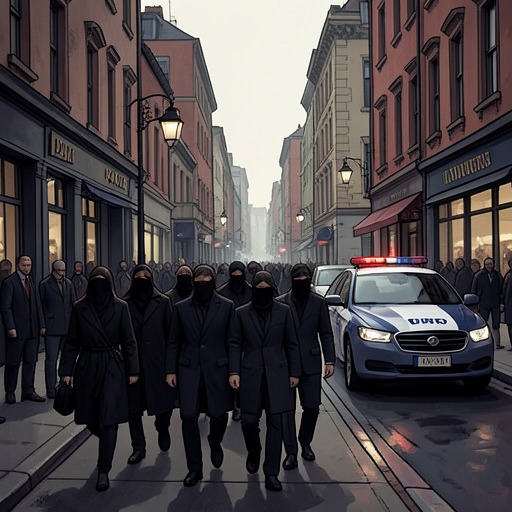
The novel distinguishes the Perón government’s reception of European fugitives from the later military regime’s machinery of repression, while connecting both to Cold War anticommunism. It traces the military campaign known as Operativo Independencia to a decree issued by María Estela Martínez de Perón on 5 February 1975. Presented as an operation against guerrillas in Tucumán, it divides the country into five military zones and gives their commanders broad power to repress those labeled subversive. General Acdel Vilas describes the objective as cultural as well as military; the resulting terror reaches teachers, students, intellectuals, artists, scientists, and religious figures.
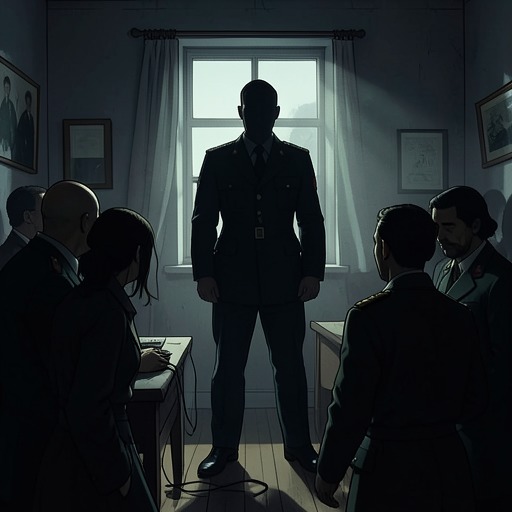
After the 1976 coup, repression becomes a clandestine system of forced disappearance. The account estimates that around thirty thousand people were victims between the spring of 1976 and the autumn of 1982, while acknowledging that figures vary because many bodies were never recovered. Specialized task groups carry out abductions, secret detention, torture, executions, corpse disposal, and the removal and reassignment of babies born to detained women. At the extreme end of this division of labor are the death flights, in which living prisoners, bound and drugged, are thrown from military aircraft into the sea. This machinery of erased bodies and identities gives the novel’s earlier concern with forged papers and hidden lives a brutal political counterpart.
The government’s place in the novel is therefore defined by a sharp historical contrast: Argentina first offers a state-supported haven to people escaping postwar accountability, then becomes the source of mass terror that drives its own residents into exile. The repeated crossings of the Atlantic are not equivalent experiences, but they reveal how regimes and international alignments determine who may find shelter, who remains beyond justice, and who is compelled to leave home.